¶ Tasks
Use tasks to plan and track compliance, security and governance work: carrying out a risk assessment, following up a control, revising a policy or anything else that needs doing. Tasks can be assigned to team members with priorities, due dates and statuses, grouped on task boards, and repeated on a schedule.
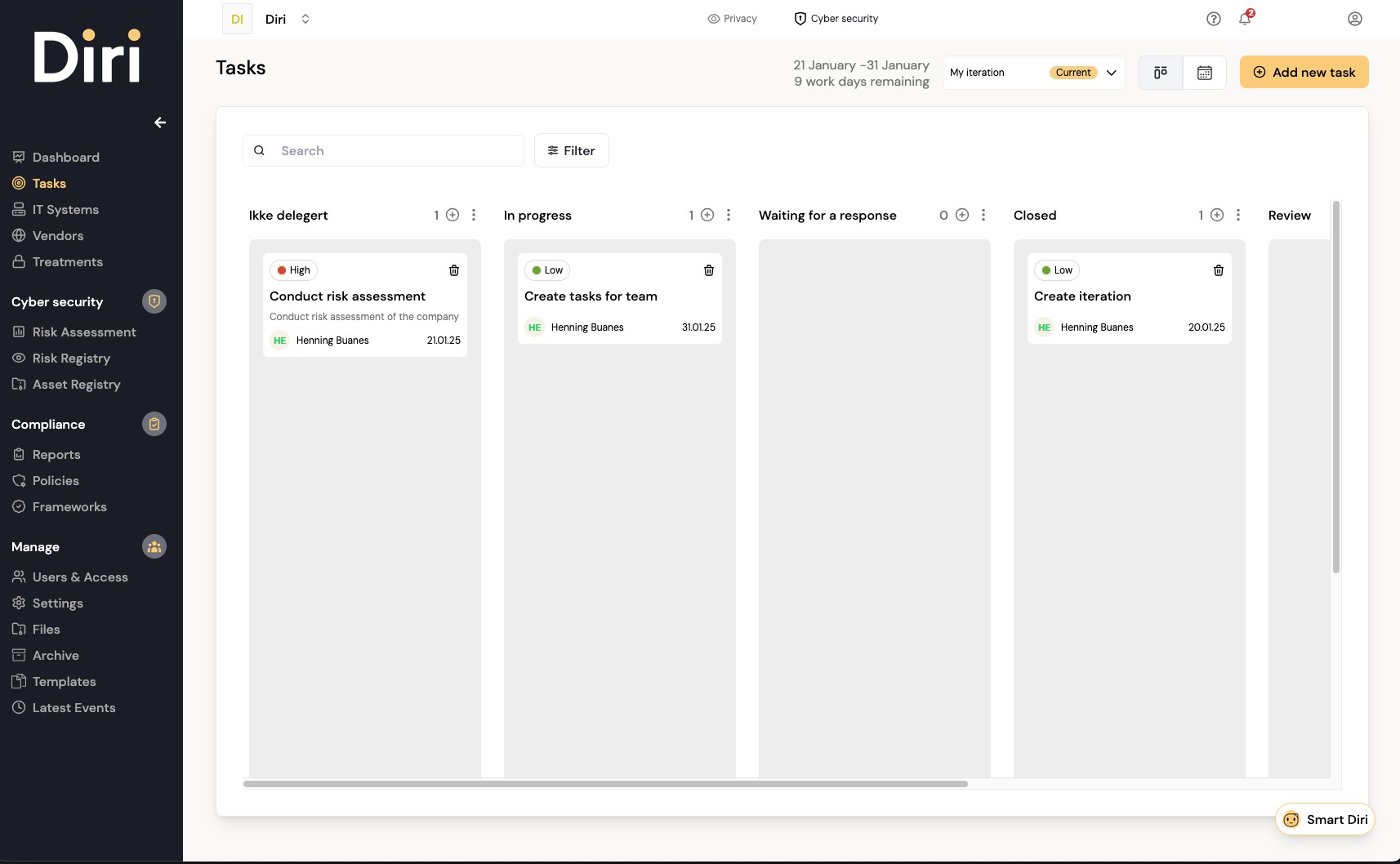
Open Tasks in the left menu. The page shows all tasks registered in the active organisation.

¶ Kanban and table view
Switch between two views with the buttons at the top of the page:
- Kanban – tasks as cards in columns. Drag a card to another column to change its status.
- Table – tasks in a list that you can search, filter, sort and export with Download CSV.
You can search the tasks and filter them on Assigned to, Priority and Status.
¶ Columns
The columns on the board are the task statuses. The first column on a new task board is Not started.
- To rename a column, click its title.
- To add a column, use the add button to the right of the last column.
- To delete a column, open the column menu and choose Delete column. You are asked to confirm. Move any tasks you want to keep to another column first.
The Closed column marks a task as done. It can be renamed and moved, but not deleted. Tasks in the Closed column, or in any column to the right of it, count as finished.
¶ Task boards
Task boards group tasks – for example by period, sprint, topic or team. (Task boards were previously called iterations.) Tasks that are not on a task board belong to the default board.
- Click Select task board and choose New task board.
- Enter a Task board name, a Start date and an End date.
- Save.
The task board list marks each board as Current, Future or Past. When a board is selected, the page shows how many work days remain, or how many days it is overdue. To edit a board, select it and click the dates shown next to the selector. Deleting a task board does not delete its tasks: they are moved to the default board.
¶ Creating a task
Click Add new task in the top right corner, or the add button at the bottom of a column.
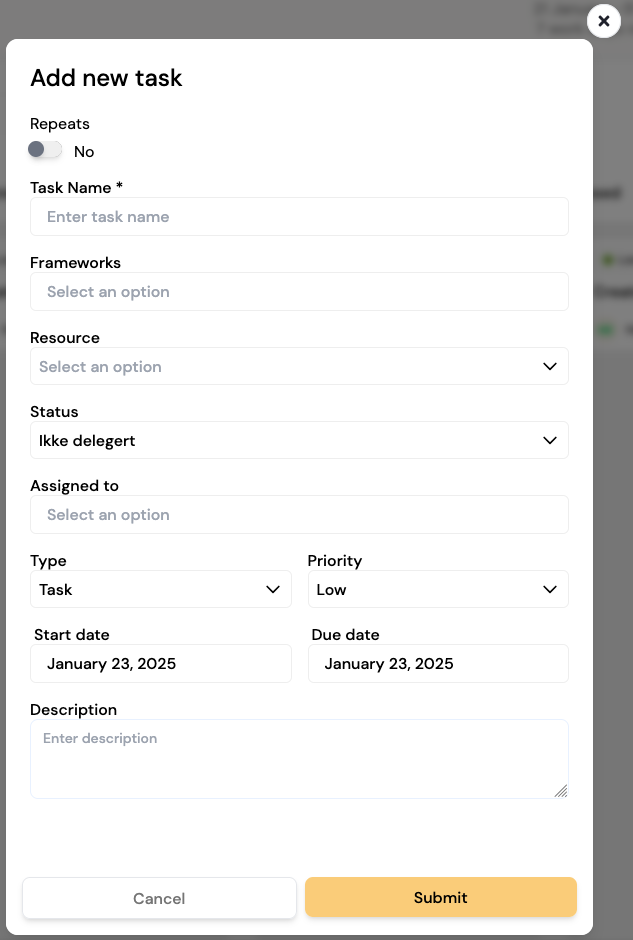
Only Task Name and Status are required.
- Task Name – what needs to be done.
- Status – which column the task is in.
- Assigned to – the user responsible for the task. The user is notified, also when you assign a task to yourself.
- Type – Task, Request or Breach.
- Priority – Low, Medium, High or Critical.
- Start date and Due date – when the work begins and when it must be done.
- Task board – leave empty for the default task board.
- Resource – link the task to a record in Diri, such as a risk assessment, treatment, vendor, IT system or policy.
- Control tags – link the task to framework controls. See Controls and evidence.
- Description – details of the task.
Open a task to comment on it and attach files, for example evidence for a control.
¶ Recurring tasks
For activities that come back on a schedule – such as quarterly access reviews or a yearly policy revision – make the task recurring.
- In the task form, turn on Repeats.
- Choose how often: Daily, Weekly, Monthly or Yearly, and the interval in Every (for example every 2 weeks).
- The Start date is the first occurrence. The Due date sets how long each occurrence has: every occurrence gets its own due date, the same number of days after its start.
- Under Ends, choose Never, On date, or After a number of occurrences. The form previews the next occurrences.
Only the current and the next occurrence are shown on the board; new ones appear automatically as their date arrives. When you close an occurrence, Diri tells you when the next one is due. When you delete a recurring task, you can choose to delete only that occurrence or all occurrences with Delete all instances of this task.
Tasks also appear on the annual wheel. Activities repeating every two months or less often get a marker in each month they fall due; activities repeating more often (daily, weekly, monthly) are gathered in the wheel's inner ring, Ongoing. A task without repetition appears as a single marker in its due month.
¶ Sharing tasks with sub-organisations
If your organisation has sub-organisations, you can offer a task to the organisations below yours. In the task form, use the inheritance settings:
- Use inherited – the sub-organisations can work on the task: move it across their board, comment and attach evidence. Each organisation tracks its own progress, so a task bound to a control can be completed by whoever it is delegated to.
- Can modify – additionally lets them change the task itself: what it is, when it is due and who answers for it.
See What is offered to the organisations below.
¶ Importing tasks
Use Import tasks to import tasks from Excel or CSV. Tasks are imported into the selected task board; if no board is selected, they are imported without one. See Bulk import.
¶ Notifications
Users are notified when a task is assigned to them, when a task assigned to them is due in 7 days, and when it is overdue. Each user chooses which notifications they receive in the app and by email under My Account.